NFC Tag vs QR Code for a Physical Sign: Which Should You Use?
By OwnQR · Published · Updated
For a sign, the most important distinction is not whether NFC or a QR code is newer. It is what you expect a person to do in front of the sign. A QR asks them to point a camera at a visible pattern; an NFC tag asks them to bring a compatible phone near an embedded chip. Both can send a visitor to a web page, but they have different failure modes, production costs and accessibility considerations. For an overview of how QR codes encode data and how scanning works, see the OwnQR guide to QR codes.
If the sign must work from a distance, be understood without explanation, or use only ordinary printing, a QR code is usually the simpler starting point. If visitors will intentionally touch or tap a designated spot and the tag can be protected inside a fixture, NFC may offer a useful interaction. A combined QR + NFC sign can provide two routes to one destination without promising that every phone behaves identically.
Compare the actual visitor experience
| Question | QR code | NFC tag |
|---|---|---|
| What does the person do? | Open a camera or QR reader and aim at a printed symbol | Hold a compatible device near the marked tag location |
| Does the sign need electronics? | No; the pattern is printed or displayed | Yes, a physical tag chip and antenna, often passive |
| Is it obvious where to interact? | A visible QR pattern is recognizable | Mark the tap point clearly, often with an NFC symbol |
| Can the sign be read without close contact? | Often yes, depending on symbol, lighting and camera | It is a near-field interaction; user typically approaches the tag |
| What if the camera cannot read it? | The pattern may be damaged, obscured or poorly reproduced | Not applicable; other failure conditions apply |
| What if the phone cannot read the tag? | Not applicable | NFC may be disabled, unsupported or unavailable in the current phone state |
Use the table to design a sign around the actual movement and device needs of visitors; it does not rank measured conversion rates.
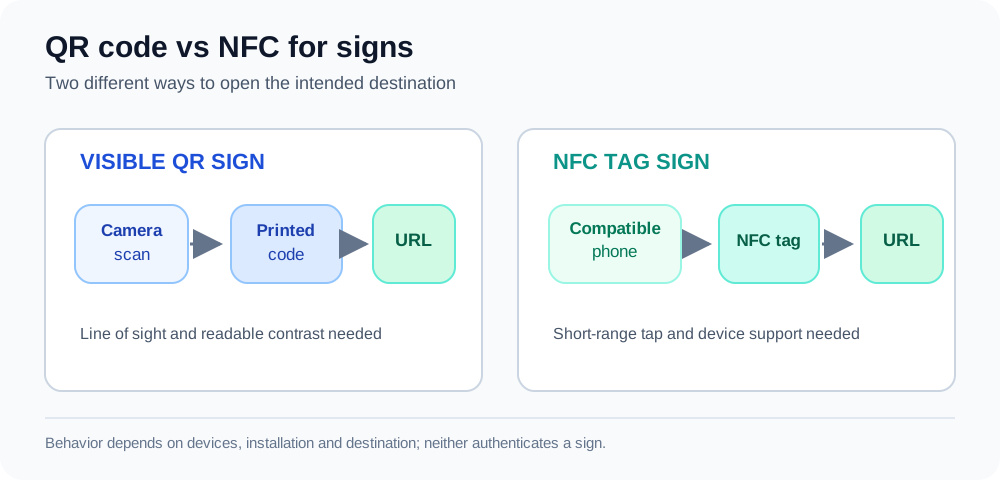
Figure: QR code and NFC signage can lead to the same destination through different physical interactions. Actual phone and tag compatibility must be checked.
iPhone and Android: do not assume “automatic tap”
Apple documents background NFC tag reading on iPhone XS and later. The system can display a notification after recognizing an eligible NDEF URI tag, and the person may need to tap the notification and unlock the phone. Apple also lists circumstances when background reading is unavailable, including certain device states and airplane mode. In other words, “just tap and it always opens” is not a safe promise. See Apple's Core NFC guidance.
Android behaviour depends on device and platform version. Android Developers' NFC documentation explains how web-link tags are dispatched and notes changes across recent Android releases, including a user-interaction step for web links on Android 17. The phone must have usable NFC capabilities and appropriate settings.
QR codes also depend on the scanner and camera. The benefit for signage is that the interaction can be shown visually: print the code, label what it opens, and provide a readable destination or alternative contact route when appropriate.
Cost: compare the whole sign, not just one tag price
A QR code is artwork: there is no chip cost, but the sign still costs money to design, print, mount and maintain. NFC adds a component price, programming or encoding work, and potentially protective construction. If the tag must operate when mounted against metal, ordinary stickers may not behave like specially designed on-metal tags.
NFC vendors offer different chip types, substrates and quantities. Instead of applying an undated generic price, request comparable quotes with a quote date, chip specification, mounting substrate, programming, delivery and expected replacement quantities. Compare installed cost per readable sign, not sticker price alone. No current vendor price is asserted here.
The hidden cost is maintenance. If the destination changes, both media may continue to work when they encode a stable address that you control and can redirect. Conversely, a printed static URL that points straight to a removed page can fail at the destination; an NFC tag storing the same removed address has the same problem. The ability to manage the web destination is distinct from the physical carrier.
Metal, weather, damage and tampering
A passive NFC tag uses an antenna. Its performance can be affected by nearby metal and mounting materials; an on-metal NFC tag is engineered for that environment. Chip durability figures published by manufacturers describe specified components under specified conditions, not a guarantee that a finished outdoor sticker survives rain, heat or vandalism for the same period. For example, NXP publishes characteristics for its NTAG21x family; actual sign durability also depends on encapsulation and installation.
A QR code has no electronics, but scratches, glare, fading, overprinting and dirt can interfere with camera recognition. QR error correction can tolerate certain damage without making every damaged symbol readable. Neither medium authenticates the destination simply by being present: a printed QR can be covered by a malicious replacement sticker, while an inadequately secured NFC tag can potentially be replaced or reprogrammed.
Practical controls are often mundane: inspect high-traffic signs, use tamper-evident mounting where appropriate, label the expected domain, and investigate unexpected URLs. For sensitive actions, let the destination page enforce authentication and validation rather than relying on the sign itself.
Neither a printed QR code nor an NFC tag is an assurance that a sign has not been replaced. For QR-based public displays, a practical companion is the QR sticker-tampering inspection guide, which covers approved artwork, sign checks and response steps. It addresses the physical display; it does not promise device-level authentication or protection against every attack.
Which medium works for which sign?
| Signage situation | Practical starting point | Why |
|---|---|---|
| Poster seen across a room | QR + short visible URL | Visible remote interaction is useful |
| Table tent or restaurant counter | QR; optionally NFC | Simple print replacement; a tap option may help nearby visitors |
| Small embedded product fixture | NFC, plus text or QR where space allows | Intentional near-field interaction can suit an embedded mounting point |
| Metal equipment panel | Printed QR, or tested on-metal NFC | Standard tag performance against metal should not be assumed |
| Public notice with accessibility concerns | Two interaction routes plus a readable alternative | Not every reader uses the same phone or interaction method |
| Reusable exhibition display | QR + NFC to the same controlled URL | Provides choice while reducing content-maintenance duplication |
These recommendations follow the interaction and mounting constraints above; choose a representative sign and test it before deploying the entire batch. If the sign must also work for readers who cannot or prefer not to scan, our accessible QR code checklist covers how to offer a route that does not need the camera.
A five-question decision method
Before ordering anything, answer these questions in sequence:
- Distance: Will people be close enough to touch the sign, or do you need interaction from farther away?
- Visibility: Is a recognizable code desirable, or must the interaction be integrated into a small object?
- Compatibility: What phones and operating systems are common in the audience? Provide an alternative if uncertain.
- Environment: Is the surface metal, wet, high-glare or frequently cleaned? Specify materials accordingly.
- Maintenance: Who controls the URL, checks the destination and replaces damaged or altered signs?
If either technology fails one of these tests, redesign the interaction before comparing visual appearance.
How OwnQR fits
OwnQR creates standard QR codes for URLs; it does not manufacture, program or sell NFC tags. A static URL QR from the OwnQR QR generator directly carries the URL entered. Its usefulness depends on that address continuing to work. If you build a dual-medium sign, configure your NFC tag separately and make both point to the intended destination. Verify both paths on representative devices before distribution.
Frequently asked questions
Can an NFC tag and QR code lead to the same page?
Yes. Store the same suitable URL in the NFC tag and encode it in the QR. Test the two paths separately; one working does not prove the other works.
Do I need a special app to scan an NFC sign?
Not always. Supported phones may handle properly formatted URI tags through system features, but behaviour depends on device, settings and platform version.
Can I put an NFC tag directly on metal?
Choose a tag specifically designed for metal mounting and validate the complete fixture. Do not assume an ordinary NFC sticker will work in that environment.
How can I compare the total cost of 500 signs?
Ask for dated quotations for 500 finished, installed signs in each format. For NFC include chips, encoding, special on-metal materials and replacements; for QR include print quality, protective finish, installation and replacement. Then divide each total by the number of working signs. Without quotes, there is no reliable winner.
Is NFC more secure than a QR code?
Neither medium alone guarantees that a destination is safe or authentic. Think about who can replace or modify the physical carrier and what safeguards the destination uses.
Sources
- Apple Developer, Adding Support for Background Tag Reading — publication date: NOT_PROVIDED; study/event period: NOT_APPLICABLE; consulted November 2026.
- Android Developers, NFC basics — publication date: NOT_PROVIDED; study/event period: NOT_APPLICABLE; consulted November 2026.
- NFC Forum, NFC Technology — publication date: NOT_PROVIDED; study/event period: NOT_APPLICABLE (technical reference); checked November 2026.
- NXP, NTAG213/215/216 product information — publication date: NOT_PROVIDED; study/event period: NOT_APPLICABLE; consulted November 2026. Component specifications do not prove outdoor sign performance.
- DENSO WAVE, QR Code error correction — publication date: NOT_PROVIDED; study/event period: NOT_APPLICABLE; consulted October 2026.
- No dated NFC supplier prices or real-device QR/NFC comparison results are claimed.