GS1 Digital Link QR Codes: URL Structure, GTINs and Checkout Readiness
By OwnQR · Published · Updated
A GS1 Digital Link QR code is a standard QR symbol whose encoded URL follows GS1 rules for representing product identifiers and associated data. The physical symbol need not look different from an ordinary QR code; the structured URL is what matters. For background on the carrier itself, see our QR code overview. This matters because a phone may treat it like an ordinary link while a compatible retail system can interpret the product identifier carried in that link.
The key distinction is between a QR image that opens a product page and a standards-structured product identifier inside a QR image. The former may work well for shoppers without being sufficient for a retail checkout system. The latter requires correct GS1 data, a conforming URI structure and the appropriate verification with retail partners.
Read a GS1 Digital Link URL, part by part
Here is an illustrative structure:
https://example.org/01/09520123456788/10/LOT42?17=271231
This is a syntax illustration using a hypothetical domain and example data, not a claim that this URL is registered, resolves, or passes a real point-of-sale test.
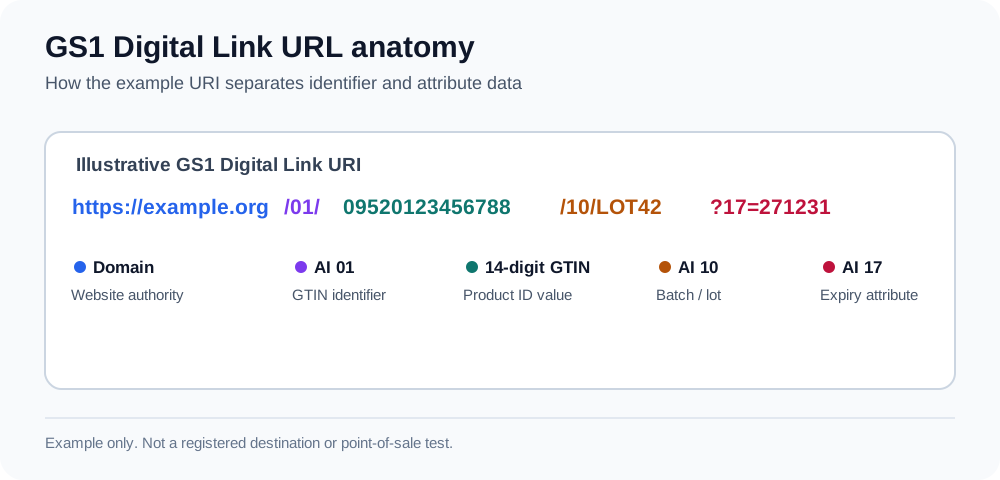
Figure: A GS1 Digital Link URL syntax illustration; the example domain is hypothetical and is not a verified live product identifier or checkout test.
| Part | Meaning | Important constraint |
|---|---|---|
https://example.org | Web domain carrying the identifier | A real deployment needs a suitable domain and web endpoint |
/01/ | GS1 Application Identifier 01 | Signals that a GTIN follows |
09520123456788 | GTIN expressed as 14 digits | Shorter GTIN formats get leading zero filler characters |
/10/LOT42 | Lot or batch qualifier | Qualifier ordering follows GS1's defined sequence |
?17=271231 | Example attribute in the query | Attributes and escaping must follow the relevant GS1 syntax rules |
The normative source is GS1 Digital Link URI Syntax Release 1.7.0. It requires a 14-digit representation for GTIN in the URI, including zero padding for GTIN-8, GTIN-12 and GTIN-13, and specifies a defined order for key qualifiers. Older forms that used words such as /gtin/ instead of numeric Application Identifiers are legacy syntax; do not copy them into a new implementation merely because an old article shows them.
A domain does not need to be id.gs1.org for every GS1 Digital Link use. That domain is relevant to the standard's canonical URI definition. Brand-owned domains can be used under the broader syntax rules. A domain alone does not prove a URI is valid or that a retailer will support it. A GS1-conformant resolver can connect one structured GS1 identifier to different online resources, such as a product detail page or a traceability record; it directs requests to the selected destination rather than storing all of those resources itself. GS1 also explains that a simple one-to-one web redirect can be used without deploying a conformant resolver. In that arrangement, the QR still encodes a GS1 Digital Link URI; the website hosting that structured URI then redirects the request to a destination page.
The URL structure matters independently of the square barcode that carries it. If you are choosing between QR Code and Data Matrix for a specific packaging or industrial workflow, compare the relevant standards, reader capabilities and available space in QR Code vs Data Matrix. An arbitrary URL placed in a QR code is not automatically GS1 Digital Link compliant.
Why does a GTIN need 14 digits in the URL?
GTIN-8, GTIN-12 and GTIN-13 remain valid identification formats, but GS1 Digital Link represents them in a consistent, 14-digit field. A GTIN-13 therefore receives one leading zero. The extra zero is padding, not a new product identity. Crucially, identifiers must be treated as text: spreadsheet software that removes leading zeros can silently corrupt the value that gets placed in the URL.
Before constructing the URI, obtain an assigned GTIN through your local GS1 Member Organisation (or confirm the valid GS1 assignment already held for the product). A QR generator cannot assign a GS1 identifier.
The last digit of a GTIN is also a check digit. It helps detect certain entry errors but is not an authentication code. A familiar modulo-10 algorithm works from right to left on the body digits, applying alternating weights of three and one and selecting the final digit that makes the weighted sum divisible by ten.
Worked check-digit example: 9520123456788. Take the first 12 digits, 952012345678, and apply weights 1, 3, 1, 3… from left to right for this 12-digit body (equivalently, 3 then 1 from the right):
| Body digits | Weight pattern | Weighted subtotal |
|---|---|---|
9 5 2 0 | 1 3 1 3 | 9 + 15 + 2 + 0 = 26 |
1 2 3 4 | 1 3 1 3 | 1 + 6 + 3 + 12 = 22 |
5 6 7 8 | 1 3 1 3 | 5 + 18 + 7 + 24 = 54 |
| Total | 102 |
The next multiple of ten is 110, so 110 − 102 = 8, the final check digit. Padding a GTIN-13 to 14 digits gives 09520123456788 in a GS1 Digital Link path such as /01/09520123456788. The GTIN is still the same identifier.
Software verification, not retail certification: Two differently written check-digit implementations in the same research script agreed on large synthetic datasets, and tested single-digit substitutions were rejected. The software also showed that a longer GS1-style URI could require more QR modules than a short redirect, but a short redirect alone does not carry the standardized product identifier. These checks do not establish GTIN registration, printed-code quality or retail POS compatibility. Full sample sizes and the error-correction level appear in Sources.
The same research encoder compared illustrative payloads at error-correction level H. Longer structured URIs can need more QR modules even when they encode the same GTIN:
| Synthetic encoded address | URL bytes | Level-H QR version | Symbol modules across (excluding quiet zone) |
|---|---|---|---|
GS1 URI on id.gs1.org, GTIN only | 36 | V5 | 37 |
| GS1 URI on an example brand domain, GTIN only | 43 | V5 | 37 |
| Example brand-domain GS1 URI with GTIN, lot and serial | 67 | V8 | 49 |
| Example short redirect with no encoded GTIN | 27 | V4 | 33 |
These are software-encoding results, not print-size recommendations, product registration checks or retail POS trials. The short redirect row is an encoding-size comparison, not a GS1 Digital Link substitute.
If the digit is incorrect, changing the QR's graphic styling cannot fix the underlying identifier. Likewise, a mathematically correct check digit does not prove that a company owns or is entitled to use the GTIN.
Four mistakes to avoid before printing
| Mistake | Why it matters | Correction |
|---|---|---|
GTIN has fewer than 14 characters after /01/ | Does not follow the current URI representation rule | Preserve the value and add the required leading zero fillers |
| Spreadsheet converted a GTIN to a number | Leading zeroes can disappear | Keep GTIN in a text column from import onward |
| Check digit was guessed | The identifier may fail validation | Recalculate and compare with the authoritative product record |
| Lot and serial qualifiers are placed in the wrong order | The URI path has ordering rules | Build the path from GS1's defined grammar, not a free-form URL template |
Data attributes, special characters and percent encoding add another layer of complexity. Do not put a human-readable phrase in the query and assume a GS1 parser will understand it. Use the relevant Application Identifier, valid data format and URI-encoding rules.
Does a short URL or redirect count as GS1 Digital Link?
The GS1 Digital Link URI Syntax defines a structured path that includes Application Identifier /01/ followed by a 14-digit GTIN. For comparison, a generic redirect such as https://example.org/x7 has no /01/ GTIN segment in its encoded address, even if its destination page displays product information. That describes the encoded URI structure; it does not certify whether any particular barcode or retail scanner meets GS1 requirements.
There are valid deployment architectures involving resolvers and redirects. The distinction is that the standardized identifier and URI structure must remain correct at the point required by the specification and consuming system. A redirect service, product information website and standards-compliant carrier are related components, not synonyms. GS1's one-to-one redirect example starts from an encoded Digital Link URI, unlike a QR that encodes only an unstructured short URL.
What Sunrise 2027 actually means
GS1 US's Sunrise 2027 initiative is about industry readiness to scan and process two-dimensional barcodes at retail checkout. GS1 US describes Sunrise 2027 as an initiative supporting retailers as they prepare point-of-sale systems to scan and process two-dimensional barcodes. Its guidance also says not all 2D capabilities need to be implemented by that date. Until individual retail systems and trading partners are ready, GS1 implementation guidance calls for coexistence of the 2D code with a conventional linear barcode. The initiative does not set a universal date on which every UPC becomes invalid, and it does not make an ordinary website QR checkout-ready.
A realistic preparation checklist is:
- Obtain an assigned GTIN from the relevant GS1 Member Organisation, or verify the product's existing GS1 assignment, and preserve its digits accurately.
- Decide whether the use case calls for GS1 Digital Link in a QR code or GS1 DataMatrix, depending on the use case and trading partners.
- Construct and validate the relevant URI and product-identification data.
- Ask retail partners about their current POS scanning, placement and coexistence requirements.
- Test real printed packaging with the actual scanning systems before launch.
Packaging dimensions are a separate verification task. GS1 General Specifications Release 26.0 (January 2026), Table 5-46, gives QR module dimensions of 0.396 mm minimum, 0.495 mm target and 0.990 mm maximum for the specified GS1 Digital Link retail application, together with a four-module quiet zone. For that application, the GS1 Digital Link URI must use the uncompressed form. The QR anatomy guide explains why the surrounding quiet zone matters. The GS1 retail implementation guideline (May 2024) also discusses positioning a 2D symbol near its linear counterpart. These are context-specific GS1 implementation requirements, not a demonstration that an OwnQR-generated graphic or a particular printed label passes retail verification. Consult the applicable GS1 specification and retailer before adopting print dimensions.
Packaging compliance involves more than the identifier's text: size, quality, placement, print process and retailer implementation all matter. This article does not establish that any particular symbol passes those checks.
Can a generic QR generator make one?
A generic generator can turn a correctly formed URI into a standard QR graphic. It does not, by that fact alone, validate your GTIN, apply GS1 business rules, certify the printed symbol or confirm POS interoperability. Those are separate jobs.
OwnQR's URL QR generator can encode a URL, but only a static URL download directly encodes the GS1 Digital Link address you enter. OwnQR hosted and editable QR codes instead encode an OwnQR redirect URL without the /01/ GTIN path; under the structured-URI definition discussed here, that encoded address is not a GS1 Digital Link URI. OwnQR is not a GS1 identifier-management, GS1 validation or barcode-verification product. The generator should not be used as evidence of GS1 conformance. Brands preparing packaging should rely on the applicable GS1 specifications and their implementation partners.
Frequently asked questions
Is GS1 Digital Link a different kind of QR code?
No. The visible carrier can be a standard QR code. The difference is the standardized URI and identification data inside it.
Why is my GTIN-13 shown with a leading zero?
GS1 Digital Link expresses GTIN as 14 digits; a GTIN-13 gets one leading zero filler character under the current syntax.
Can I put a normal website URL on product packaging?
You can encode a website URL for consumer access. That alone does not make it a GS1 Digital Link identifier suitable for retailer checkout systems.
Can I put a GS1 Digital Link on a brand-owned domain?
The URI syntax permits brand-owned domains; you do not need to copy id.gs1.org merely to construct a Digital Link. A syntactically valid address still needs correctly assigned identifiers, an operational endpoint and validation with the intended systems.
Does Sunrise 2027 require every brand to switch overnight?
No. It is a readiness initiative for the transition to richer two-dimensional data carriers; concrete packaging and POS timelines need to be coordinated with supply-chain partners.
Sources
Preparation and review: Prepared by the OwnQR editorial team with AI assistance, last revised November 11, 2026, and has not undergone independent expert review. The software checks described here are not packaging or retail checkout tests.
- GS1, GS1-Conformant Resolver Standard — official technical description of identifier-to-resource resolution; Release 1.2.1, ratified August 2026; accessed November 10, 2026.
- GS1, Do I need to run a resolver to use GS1 Digital Link? — updated August 20, 2024; accessed November 10, 2026. Explains simple redirects versus conformant resolvers.
- GS1, GS1 Digital Link URI Syntax, Release 1.7.0 — ratified August 2026; accessed November 10, 2026. The 14-digit GTIN path rule and Application Identifiers are defined there.
- GS1, Quick Start Guide for GS1 Digital Link — document year 2024 (PDF metadata modified August 9, 2024; no separate publication day printed); accessed November 10, 2026. Explains
/01/and qualifiers. - GS1 US, Sunrise 2027 — retail POS readiness initiative; no last-updated date shown; checked November 11, 2026. The page does not state that POS systems must support 2D scanning by the end of 2027, and does not establish that every old barcode becomes invalid on a single date.
- GS1, General Specifications, Release 26.0 — released January 2026; Table 5-46 used for retail QR size and quiet-zone context; accessed November 10, 2026.
- GS1, 2D Barcodes at Retail POS Implementation Guideline, Release 1.0 — published May 2024; study/event: retail POS implementation; accessed November 10, 2026.
- Synthetic software check-digit and URI encoding runs: GS1 rules consulted October 26, 2026; the evidence record does not specify a precise execution day. The two arithmetic implementations agreed across 10,000,000 synthetic seven-digit bodies and 200,000 generated longer samples; 2,340,000 single-digit variants of 20,000 seeded GTIN-13 values were rejected by the algorithm. A research QR encoder—not OwnQR's production generator—produced a Version 8 level-H code for an illustrative GS1-style URI versus a Version 4 code for a shorter generic redirect. These are algorithm and encoding comparisons, not tests of live GS1 identifiers, packaging or checkout.